
Find the right technical route before the quote: material selection, flow-control parts, severe wear and forming tooling, backed by the grade and tolerance data we use in review.
Reference data
Standard grades (GB/T 18376). Typical values per the national standard — for reference. Actual properties depend on grain size, binder content and process.
| Grade | ISO | Co/Ni (%) | Grain (µm) | Density (g/cm³) | Hardness (≥HRA) | TRS (≥N/mm²) |
|---|---|---|---|---|---|---|
| YG6 | K10 | 6 | 1.6 | 14.7–15.1 | 90 | 2600 |
| YG6X | K10 | 6 | 0.8 | 14.7–15.1 | 91 | 2700 |
| YG8 | K20 | 8 | 1.6 | 14.6–14.9 | 89 | 2700 |
| YG8x | K20 | 8 | 0.8 | 14.6–14.9 | 90 | 2800 |
| YG8N | K20 | 8 | 1.6 | 14.6–14.9 | 88.5 | 2500 |
| YG10 | K40 | 10 | 1.6 | 14.3–14.7 | 88.5 | 2800 |
| YG13 | K40 | 13 | 1.2 | 14–14.3 | 87.5 | 3100 |
| YG13X | K40 | 13 | 0.8 | 14–14.3 | 88.5 | 3300 |
| YG15 | K40 | 15 | 1.6 | 13.8–14.2 | 86.5 | 3200 |
| YG15X | K40 | 15 | 0.8 | 13.8–14.2 | 88.5 | 3400 |
| YG15N | K40 | 15 | 1.6 | 13.8–14.2 | 86.5 | 3000 |
| YG18 | K40 | 18 | 1.6 | 13.6–14 | 85.5 | 3100 |
| YG20 | K40 | 20 | 1.0 | 13.4–13.8 | 85 | 3100 |
| YG20C | K40 | 20 | 2.0 | 13.4–13.8 | 83 | 3100 |
| YG25 | — | 25 | 1.6 | 13–13.2 | 82.5 | 2800 |
| YG25C | — | 25 | 2.0 | 13–13.2 | 81 | 2600 |
GB/T 18376 standard grades. For wear / impact / temperature / corrosion guidance, see the guides below.
Grades available via our partner mills for cutting-tool and PCD-body applications. Proprietary grades via partner mills.
| Grade | Grain | Density (g/cm³) | Hardness (HRA) | TRS (N/mm²) | Fracture (×10³) | Application |
|---|---|---|---|---|---|---|
| K06 | Fine | 14.93 | 92.4 | 2600 | 8 | Diamond-coated tools; graphite & composites |
| K09UF | Ultrafine | 14.45 | 93.8 | 3600 | 8 | Milling cutters, reamers; high-speed, ultra-hard materials |
| K10F | Fine | 14.45 | 91.8 | 3600 | 10 | Drills, mills; alloy steel, cast iron, stainless, heat-resistant |
| K10EF | Submicron | 14.45 | 92.2 | 3600 | 10 | Drills, mills; stainless, heat-resistant alloys, cast iron |
| K12UF | Ultrafine | 14.15 | 92.7 | 3600 | 10 | End mills, reamers; finishing alloy steel, aluminum, titanium |
| K12EF | Submicron | 14.20 | 91.4 | 4200 | 11 | Milling cutters; high-speed milling of 316L stainless |
| ES12 | Medium | 14.20 | 89.3 | 3800 | 14 | Tool bodies where the shank does not participate in cutting |
Nickel-binder grades for tooling and fixtures near magnetic fields; precision stamping plate grades with equivalents shown for cross-reference only.
| Grade | Co/Ni (%) | Grain (µm) | Density (g/cm³) | Hardness (≥HRA) | TRS (≥N/mm²) |
|---|---|---|---|---|---|
| YN11 | 11 | 1.2 | 14–14.3 | 88 | 2600 |
| YN13 | 13 | 1.2 | 14–14.3 | 87 | 2700 |
| YN15 | 15 | 1.2 | 13.8–14.1 | 86 | 3000 |
| YN18 | 18 | 1.2 | 13.5–13.8 | 84 | 3000 |
| YN20 | 20 | 1.6 | 13.4–13.7 | 83 | 3000 |
| YN25 | 25 | 1.6 | 12.9–13.2 | 81 | 2900 |
Used in forming moulds of magnetic materials, equipment guides, sealing rings and valve accessories. High hardness, long service life, good wear resistance, strong corrosion resistance.
| Grade | Grain | Co% | Hardness (HRA) | Density | Equivalent | Properties & Applications |
|---|---|---|---|---|---|---|
| K12EF | Submicron | 12 | 91.1 | 14.2 | 12EF/KD20 | Cr-added; stainless <0.6mm at <500spm; copper/aluminum foil, Li-battery |
| K15F | Submicron | 15 | 90.5 | 13.95 | H15F/CD650 | Thicker stainless ≥0.6mm; high wear & toughness; copper alloy, SPCC, aluminum |
| K10F | Submicron | 10 | 91.8 | 14.45 | H10F/KD10 | Thin stainless 0.1–0.3mm; phosphor bronze >500spm; lead frames |
| KS12 | Medium | 12 | 89.5 | 14.2 | H12F/KR466 | Copper ≥0.3mm; high-strength steel ≥0.4mm; silicon steel; high impact toughness |
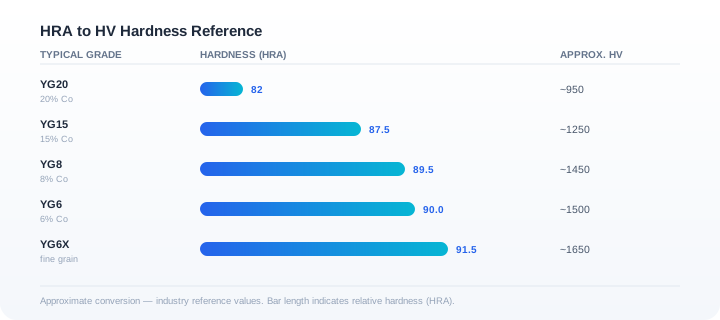
Hardness is quoted in different scales. This chart maps Rockwell (HRA) to Vickers (HV) for common cemented carbide grades.
Four stable routes
Choose a topic to see every guide in that group. All 95 current articles are indexed once across these four pages.
What the ASTM B276 porosity rating means in service — micro-pores, coarse voids, free carbon.
Open guide →Low-angle micro-cutting vs high-angle impact fracture, and how grade choice changes the outcome.
Open guide →As-sintered vs ground vs lapped — and where to spend the tight tolerance.
Open guide →